Models of grief
Grief, often cited as “the price we pay for love”, is an unavoidable human experience. So it’s ironic that it can often be lonely and isolating; we struggle to put words to our loss in the hope others might grasp at least some of the desolation we feel. Not many of us are ‘loss literate’, simply because it’s not taught to us and our culture is rather avoidant of the topic. But we can learn, whether for ourselves in times of grief, or in support of those who are bereaved in some way.
I’ll share with you some models of grief created by experts - psychologists, theorists, grievers - that can help make some sense of the process. Before we dive into those I want to point out a few things:
there is no right or wrong way to grieve, and that these models are not step by step instructions nor are they ways of dodging the deeply painful experience of loss. They are simply interpretations of the experience of grief and knowing them can help you to feel that what you’re going through is understood by others and what you’re feeling is normal. They may also provide some hope for things to get more manageable, in time.
when I speak of grief, I do not just mean mourning someone who has died. We can grieve relationships, jobs, pets, lost opportunities, parts of ourselves…there isn’t really a limit. You can read about ambiguous loss here.
“Grief, I’ve learned, is really just love. It’s all the love you want to give but cannot. All of that unspent love gathers up in the corners of your eyes, the lump in your throat, and in that hollow part of your chest.”
The 5 stages
Let’s start with the most well known theory on grief: Kubler-Ross’s 5 stages of loss. It was probably frustrating for KR to have her theory so often distilled down into something overly simplistic, which is the most common criticism of it. So, we must approach this concept with the awareness that these stages are not linear or rigid. There is more depth and complexity to this theory than I’ll go into here, so if the idea makes sense to you and you want to know more you can visit the website or read her book on the subject. The book was originally written for the dying, not the bereaved, but for many the process of loss/change is similar regardless of circumstance.
In brief, the concept is that when we experience significant change or loss, many of us go through a series of experiences. What I notice as a therapist, explaining these stages to clients, is the relief at knowing what what they’re experiencing is normal.
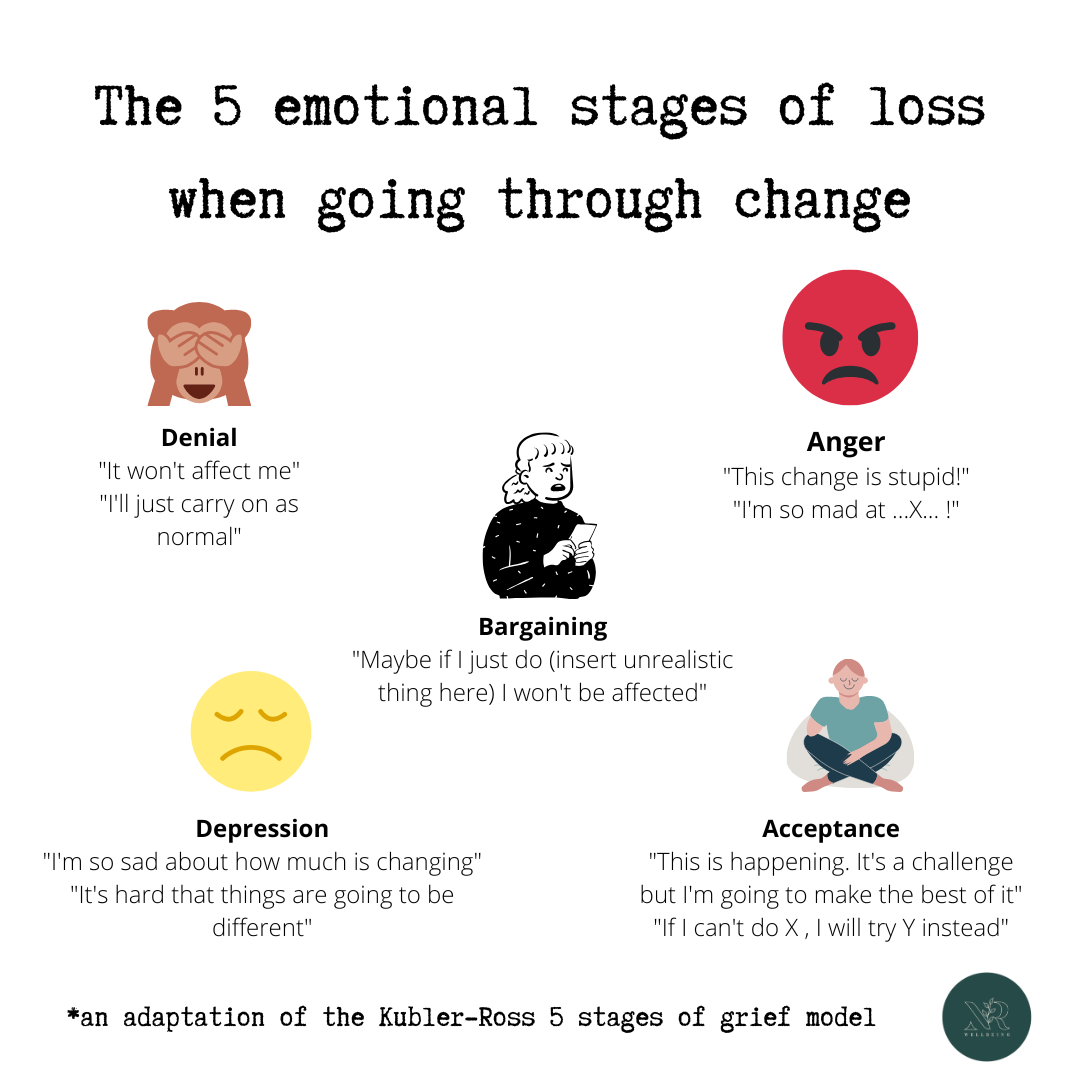
In therapy, after explaining the stages, a client might identify which stage they’re in and what that’s like for them. The goal is not to go through each stage as quickly as possible, so whilst we might work on any feelings of stuckness, the purpose it more to acknowledge where they are, validate this and help them know what to expect as they go through the grieving process.
Apply the theory: If you’re dealing with loss/change at the moment, take a look at the 5 stages and see if any of them resonate with you. You might oscilate between a couple of them, things changing day by day. Try to accept that this is your experience right now, and it’s ok to be feeling this way. What do you need to support you through this stage?

Growing Around Grief - Tonkins
Dr Lois Tonkins was a grief counsellor, researcher and writer. Her son died in an accident when he was 22, so her own experience informed her work. Many people find the idea of ‘moving on’ very difficult, so this model is very appealing as it does away with the idea of trying to shrink your grief. Instead, Tonkins explains how, with time and care, your life can grow around your grief so that the loss is an indelible part but not the only or even main aspect of your life. The loss is never forgotten, it is integrated.
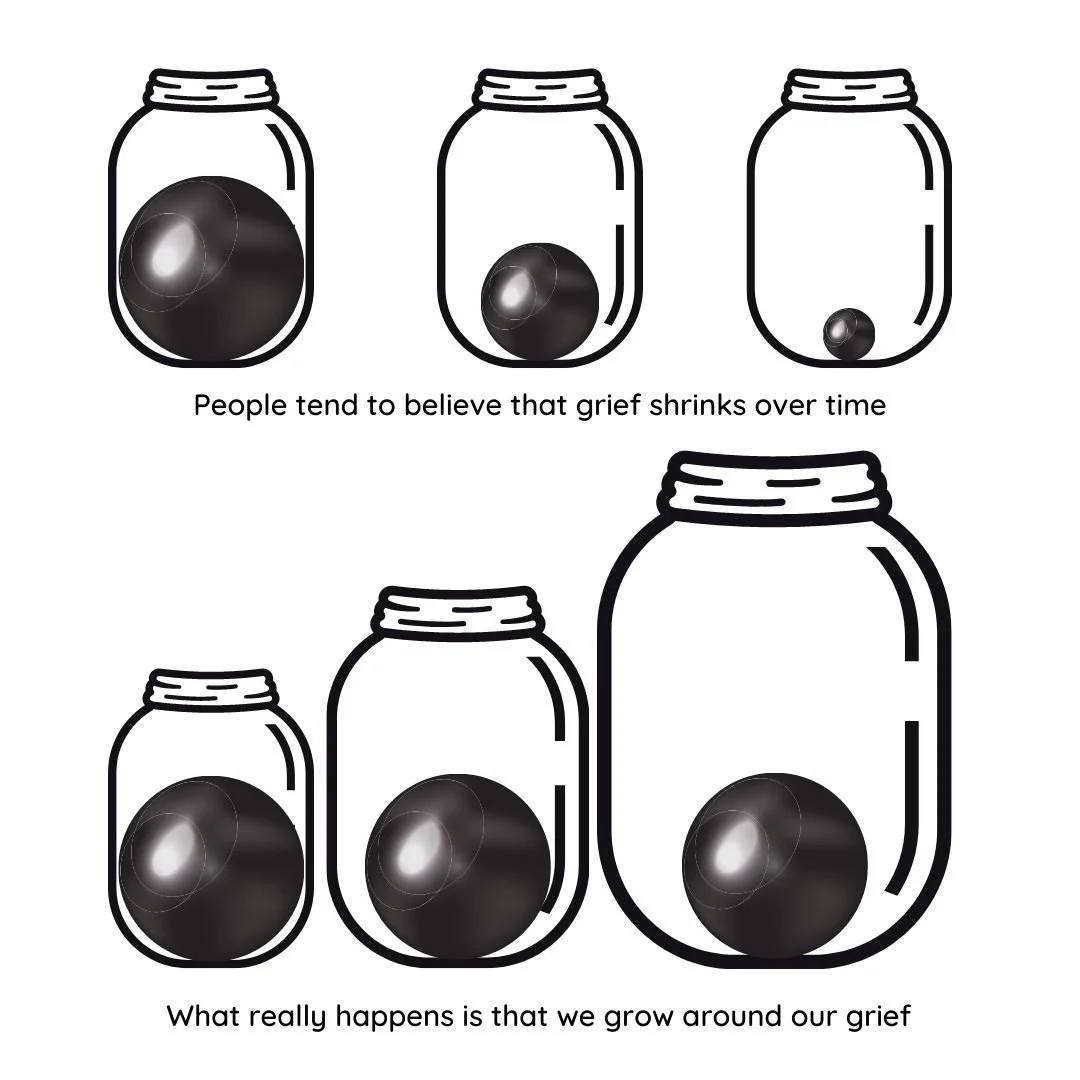
In this model, grief is represented by the black ball. Tonkins shows us that we don’t shrink it, we allow life to expand around it. At first, the loss feels all encompassing, taking up all the space in your mind and altering your life completely. The assumption might be that we need to make the grief smaller, which feels impossible. Instead, Tonkins explains we allow time and life to continue on and eventually, the jar (life) gets bigger around the grief. You might imagine other balls of different colours getting added to the jar in time. These are your other relationships, interests and experiences . The person (pet, part of yourself or thing) you lost is always a part of your life and your story, but the story does continue.
Making meaning
This is less of a model and more of an approach, of which there are many powerful examples through history. Grief educator David Kessler writes that finding meaning is really a follow on from the 5th Kubler-Ross stage (acceptance) of loss and is a living embodiment that a rich and fulfilling life is possible even after experiencing devastating loss.
Making meaning doesn’t have to mean literally about someone’s death - sometimes random and tragic things happen. It’s about how experiencing profound loss changes how you see life; perhaps ridding you of the ability to care about stuff that doesn’t matter, or focusing you on your goals, changing your perspectives. It might be about living in a way that honours your loved one, gives you a cause to fight for or simply helps you align with your values.
Probably the most well known example of this concept, perhaps we could even call him the father of it, is Viktor Frankl. Frankl was a psychiatrist, neurologist and holocaust survivor. Most of his family and community were murdered in the second world war, and afterwards he wrote Man’s Search For Meaning, which I think should be required reading for all human beings. He doesn’t shy away from describing the brutality of loss, which makes his words on finding hope, purpose and meaning all the more powerful.
“If there is a meaning in life at all, then there must be a meaning in suffering. Suffering is an ineradicable part of life, even as fate and death. Without suffering and death, human life cannot be complete.”
Similarly, Mo Gawdat , entrepreneur and former Google exec, has spoken frequently and eloquently about the unexpected loss of his son and how he transformed his devastation and depression into meaning. He talks about embracing the painful emotions and emphasises the importance of choosing which thoughts you allow to influence your actions.
There are many examples of people who’ve experienced terrible loss and gone on to start foundations, run marathons or write books. But you don’t have to do anything major like this to find meaning, these can simply be inspiration and hope rather than templates to follow. Your grief is unique to you, and whilst that can feel daunting and even lonely, it also means that only you can decide what feels right and necessary.
How therapy helps
There is no cure for grief. It’s the price we pay for love and an unavoidable part of life. Not everyone who’s grieving needs counselling, but sometimes it can feel too much to carry on your own. A therapist gives you the time and space you need to talk about your loss, feel your emotions without judgement, to start to integrate the loss. Unlike family and friends, therapists don’t have an agenda or time frame for your grief. Sometimes, just having a caring witness is enough to ease the pain, but as well as listening fully to your experience, a therapist can help you identify ways you can make sense of what’s happened and learn to live well with your loss.
Further support
There are many resources and types of support available. Here are some recommendations for more information and services.
What’s your grief - quality education & courses: https://whatsyourgrief.com/
David Kessler - resources, support, education: https://grief.com/
Cruse bereavement support service: https://www.cruse.org.uk/
Blue cross pet loss: https://www.bluecross.org.uk/pet-loss-support
Neuroscience of grief explanation by Dr Nas
Book: Grief Works by Julia Samuel